Edith (Edy) Turner
Wané Roonseraw · c. 1754 – 1838
Chief, linguist, social activist and business woman of Southampton County — one of the past leaders to whom the Nottoway people remain eternally grateful.
André L. Williams, Ph.D.
Associate Professor of Criminology and Criminal Justice · Enrolled Tribal Citizen of the Nottoway Indian Tribe of Virginia
Nottoway Indians live a contemporary lifestyle and we are not frozen in the past.
While our community is working tirelessly toward maintaining practices that are rooted in the past, we are diligently working to apply those practices that define our place in contemporary society. Nottoway culture allows our people to deal with the realities of contemporary society, not by embracing a new fad, but by continuing to absorb new traditions on our own terms. Like other Nations across Indian Country, Nottoway people are striving to maintain our culture. Suffice it to say, culture is not just the remnants of the past, but also patterns of thought and cycles of behavior that shape the basic building blocks of Nottoway life. We the Nottoway are eternally grateful for the untiring efforts and sacrifices of one of our past leaders — Wané Roonseraw.
Wané Roonseraw, born circa 1754 and died 1838, who took the English name Edith Turner (Edy Turner), was a renaissance woman of the 19th century in Southampton County, and on many occasions she was referred to as “Queen” or “Chief.” On one account, Turner was depicted as an astute business woman. Although Turner was not a learned woman, she was described as highly intelligent and a skillful conversationalist. In addition to her command of the English language, she was also fluent in her native tongue, the Nottoway language (Morse, 1822). In fact, in 1820 former President Thomas Jefferson dispatched Wood, a professor at the College of William and Mary, to record the Nottoway language — a word list containing over 200 words — as dictated to Wood by Turner. Later it was determined by Du Ponceau that the Nottoway language was of an Iroquoian language stock (American Philosophical Society, 1820).
Through the distressing years of our history, the strong-willed Wané Roonseraw (Edy Turner) was faced with many disturbing issues. For example, she was faced with providing a safe haven for Nottoway children who found themselves as orphans, and she fought diligently to maintain the Nottoway culture for those who were to come after her. Additionally, Turner argued that by Treaty rights Nottoway children were to stay on the reserve and they were not to serve as apprentices or indentured servants to Caucasian planters in the surrounding communities in Southampton County.
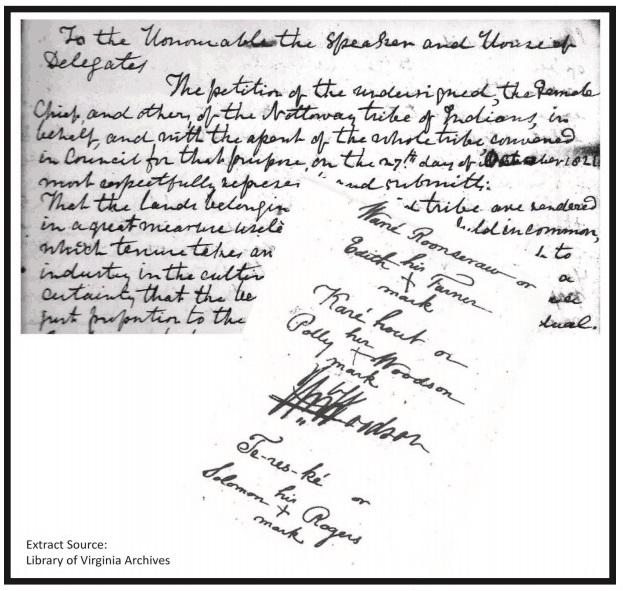
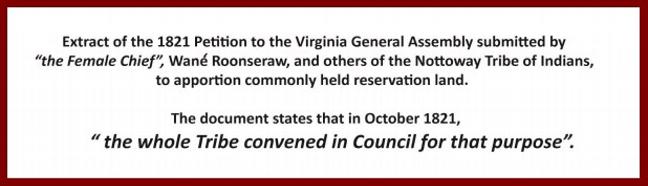
Prior to the turn of events for the Nottoway, 19th century America was a tempestuous period for American Indians. Many Indians were forced from their sacred lands via the Removal Act of 1830, which was led by former President Andrew Jackson. The Nottoway people were not affected by the Removal Act of 1830; however, the Nottoway who had inhabited their sacred lands in Southampton County for many years found themselves pressured to accept the economic system, politics and religiosity of the dominant culture of that epoch. Consequently, on October 27, 1821, Turner petitioned the Virginia General Assembly as “Chief” of the Nottoway people (General Assembly Legislative Petitions, 1821) to distribute the remaining segment of the initial 44,000-acre Nottoway Indian Reservation into individual descendant ownership allotments.
One may consider this action as the last resort for Turner and her people. Nevertheless, being politically savvy and a shrewd business person, Turner assumed allotting portions of the reserve was perhaps the only means to evade the involuntary ejection of the Nottoway people westward. Furthermore, it is important to note that other historical Indian Nations found the Nottoway reserve a safe place of refuge in their time of trouble and need.
As a social activist, politician and business person, Wané Roonseraw (Edith Turner) was a progressive thinking woman of her time, and she was a powerful force to have been reckoned with in 19th century Southampton County. Today, as 21st century Nottoway people, Turner’s fighting Iroquoian spirit continues to dwell within us.
Nuwaswekum
“They speak, it is their role.”
It is the role of Nottoway people to speak the truth, and to speak of our rich historical past, present and future for the next 7 Generations.
From the Archives
The 1821 Petition
Her Many Roles
Chief & Petitioner
Referred to on many occasions as 'Queen' or 'Chief,' she carried the political voice of her people to the Virginia General Assembly at a time when few would listen.
Keeper of Language
Fluent in her native Nottoway tongue and commanding in English, she preserved over 200 Nottoway words for the generations who would come after her.
Business Woman
Contemporary accounts describe an astute, shrewd business person — politically savvy, and strategic in protecting the reserve from involuntary ejection westward.
Protector of Children
She provided a safe haven for Nottoway orphans and argued that by Treaty rights Nottoway children were to remain on the reserve — never apprenticed or indentured to surrounding planters.
A Life in Time
c. 1754
Wané Roonseraw is born into the Nottoway community of Southampton County, Virginia. She would later take the English name Edith — Edy — Turner.
1820
At the request of former President Thomas Jefferson, John Wood of the College of William and Mary records the Nottoway language from Turner's dictation — a word list of more than 200 words. Peter Du Ponceau later determines the language to be of Iroquoian stock.
October 27, 1821
Turner petitions the Virginia General Assembly as 'Chief' of the Nottoway people, asking that the remaining portion of the original 44,000-acre Nottoway Indian Reservation be distributed into individual descendant allotments.
1830
The Removal Act signed under President Andrew Jackson forces Nations across Indian Country from their sacred lands. The Nottoway are not removed — but face intense pressure to accept the economic, political and religious systems of the dominant culture.
1838
Turner's life ends, but her fighting Iroquoian spirit endures in the Nottoway people who follow her.
References
- American Philosophical Society (1820). Correspondence on the Nottoway vocabulary.
- General Assembly Legislative Petitions (1821). Petition of the Nottoway Indians, Southampton County, Virginia, October 27, 1821.
- Morse, J. (1822). Report to the Secretary of War of the United States on Indian Affairs.
- U.S. Department of State (n.d.). Indian Removal Act of 1830.